Tariffs Are Not Just a Price Problem. They're a Classification Problem.
The companies that will win 2026 understand that tariffs are a classification problem, a chemical identity problem, and an AI orchestration problem — simultaneously. Here is the technical deep-dive no one in this industry has written yet.
shehan makani | eshan makani
4/18/202617 min read


April 2026 · Trade Compliance & AI Strategy · Specialty Chemicals
Tariff Engineering Is a Chemistry Problem.
And Agentic AI Is the Only Way to Solve It at Speed.
Most chemical distributors are treating tariffs as a cost to absorb. The companies that will win 2026 understand that tariffs are a classification problem, a chemical identity problem, and an AI orchestration problem — simultaneously. Here is the technical deep-dive no one in this industry has written yet.
SECTION 01 — THE PROBLEM MOST PEOPLE ARE MISREADING
Tariffs Are Not Just a Price Problem. They're a Classification Problem.
Every specialty chemical import into the U.S. must be assigned a 10-digit Harmonized Tariff Schedule (HTS) code — a classification that determines which duties apply, which trade remedies stack, and ultimately what the product legally is under U.S. customs law. [1] Most chemical companies treat this as a one-time compliance task handled by a customs broker. That was fine in 2019. In 2026, it is a live competitive weapon.
The current tariff landscape has created what trade attorneys are calling a "stacking problem" unlike anything seen in modern chemical trade. Section 122 (IEEPA) applies a 10% baseline to imports from most countries. Section 301 adds another 25% to 100% on Chinese-origin goods. Section 232 — expanded dramatically in August 2025 with 407 new HTS subheadings [2] — now applies a 50% duty assessed on the full customs value, not just the metal content of covered articles. [3] Antidumping and countervailing duty orders can stack on top of all of that, reaching effective rates above 200% on specific products. For Indian-origin specialty chemicals, the combined effective rate in 2025 reached 26 to 50% depending on HTS classification.
The August 2025 Section 232 expansion is particularly consequential. The HTS is no longer a static reference document. It is a living compliance surface that changes three times per year by design. [3] Inclusion request windows open for 14 days at a time, public comment periods close, and new subheadings take effect — often without adequate warning to importers who are not actively monitoring the Federal Register.
This means that a calcium chloride solution, a D-Limonene variant, or an agrochemical active that shipped under one duty structure in Q1 2025 may face a fundamentally different cost basis by Q3 2025 — not because the chemistry changed, but because the classification context changed around it.
⚠ COMPLIANCE RISK — CLASSIFICATION DRIFT
The USITC published recurring HTS revisions throughout 2025. For importers of specialty chemicals, the critical risk is 'classification drift' — where a product's HTS code, originally correct, becomes inaccurate or suboptimal as tariff annexes expand. CBP can assess back-duties, penalties, and interest on misclassified entries. In 2025, federal civil monetary penalty adjustments updated penalty figures and CBP enforcement indicators increased, significantly raising the financial stakes for classification errors. [4]
The Chemical Reaction Origin Rule: The Most Overlooked Lever in Specialty Chemicals
Here is where chemistry and customs law intersect in a way almost no one in chemical distribution talks about openly.
Under U.S. non-preferential rules of origin codified in 19 CFR § 102, the country of origin of a chemical product is determined by the "substantial transformation" test — whether the imported material has been transformed into a new article with a new name, character, and use. [5] For chemical products classified in HS Chapters 28, 29, 31, 32, and 38 specifically, U.S. customs regulations include a special chemical reaction origin rule: a good is considered to have undergone substantial transformation in the country where a chemical reaction occurred that created a new chemical entity. [5]
This has profound practical implications that most specialty chemical importers miss entirely. The rule creates a hard line between operations that change origin and operations that do not — and that line is drawn in chemistry, not in logistics.
Operations that do NOT change the country of origin: simple blending of D-Limonene with carrier solvents, dissolving CaCl₂ in water to create a solution, diluting IPA with water, repackaging, filtering, color adjustment, or redistillation. In all of these cases, CBP's position is clear — the source material retains its chemical identity, and the country of origin remains the country where that material was produced.
Operations that DO change the country of origin: a neutralization reaction that creates a novel surfactant salt, esterification of IPA to produce isopropyl acetate, epoxidation of D-Limonene to limonene oxide, salt formation between an Indian API and a U.S.-sourced acid, or catalytic conversion of a terpene to a structurally distinct derivative compound. In each of these cases, a new molecular entity has been created. The chemical reaction rule applies, and the country where the reaction occurred becomes the country of origin.
The critical CBP precedent is HQ H289712, which addressed pharmaceutical API processing. CBP ruled that combining an Indian-manufactured API with inactive ingredients and compressing the mixture into tablet form did NOT constitute substantial transformation — because, in the agency's words, the API's "chemical and physical properties were retained and its medicinal use unchanged." [6] The API went in. The same API came out. Dosage form is not transformation.
But a downstream step that chemically modified the API — changing its salt form, its stereochemistry, or its functional group — would trigger a different analysis entirely. The chemistry determines the outcome, not the number of processing steps or the complexity of the equipment involved.
For a specialty chemical distributor operating across India and the U.S., this means three things. First, simple blending or dilution in the U.S. does not change origin — the Indian-origin tariff rate still applies to the landed cost. Second, processing that causes a genuine chemical reaction can establish U.S. origin for the resulting product — this is legally established and routinely used by sophisticated importers. Third, tariff engineering — the deliberate structuring of production steps across geographies to legally optimize classification — is a recognized, entirely legitimate compliance strategy, provided the operations reflect genuine commercial activity rather than cosmetic reshuffling. [4]
✦ LEGAL FRAMEWORK — TARIFF ENGINEERING
Tariff engineering is legal when it reflects genuine commercial operations — not paper reshuffling. The line CBP draws is between operations that change the product's essential chemical identity (permitted) versus those designed solely to relabel a product that remains commercially and chemically identical (not permitted). For chemical companies, this distinction lives in the molecular structure of the product itself.
SECTION 02 — THE MECHANICS OF DUTY DRAWBACK
The Duty Drawback Mechanism: Getting Paid Back What Tariffs Cost You
Even where substantial transformation cannot be established — where the processing genuinely does not create a new chemical entity — there is a second legal mechanism that most specialty chemical distributors are dramatically underutilizing: duty drawback under 19 U.S.C. § 1313.
Duty drawback allows U.S. importers to claim a refund of up to 99% of duties paid on imported materials when those materials — or commercially interchangeable substitutes — are subsequently exported. For a company running both import and export operations across an India–U.S. corridor, this is not theoretical. It is a direct, statutory revenue recovery mechanism that most mid-size specialty chemical companies are simply not filing for.
Manufacturing Drawback — 19 U.S.C. § 1313(a)
This applies when imported materials are used in U.S. manufacture and the resulting finished product is exported. The importer receives a refund on the duties paid on the input material. For a specialty chemical distributor, this applies to any blending operation that produces an exportable finished formulation from duty-paid Indian inputs — even where that blending does not rise to the level of substantial transformation for origin purposes. The 99% refund applies. Proof of manufacture and export is required.
Substitution Drawback — 19 U.S.C. § 1313(j)(2)
This is the most commercially flexible drawback type and the most underused. It does not require the same imported material to be exported — only a commercially interchangeable substitute with the same 8-digit HTS code. For a distributor importing CaCl₂ or IPA from India while also exporting equivalent domestically-sourced product, substitution drawback allows a duty recovery claim on the Indian-origin import even when the exported product came off a U.S.-origin shelf. The filing window is five years from the date of import.
Rejected Merchandise Drawback — 19 U.S.C. § 1313(c)
When imported goods fail to meet specification — a purity shortfall in a pharma-grade intermediate, a moisture exceedance in a mineral salt shipment — and are returned to the exporter or destroyed under CBP supervision, the importer can recover the duties paid on that shipment. This is particularly relevant for high-specification chemical inputs where rejection rates have real duty cost consequences.
Deloitte's 2026 Chemical Industry Outlook explicitly flagged duty-drawback credits as a primary operational adjustment to tariff exposure that companies will "augment through 2026 with digital tools." [7] That digital tool layer is where the AI framework becomes essential — because manually tracking five-year drawback windows across dozens of import entries, matching them to export shipments by 8-digit HTS code, and assembling CBP Form 7551 packages is exactly the kind of high-stakes, documentation-intensive task that most mid-size companies simply do not staff for.
SECTION 03 — WHERE AGENTIC AI ENTERS THE PICTURE
Why You Cannot Do This Manually — And Why Agentic AI Is the Only Scalable Answer
Here is the operational reality that makes the above frameworks so difficult to execute without AI. The HTS changes three times per year. Trade policy announcements move faster than procurement cycles. Section 232 expansion rounds open and close within 14-day comment windows. [3] Binding ruling requests at CBP take months to process. Drawback filing windows are five years long but require meticulous, contemporaneous documentation from the moment of import. And none of these compliance clocks are synchronized with each other.
The "AI tourism" phase — where chemical companies ran disconnected AI pilots that generated dashboards nobody acted on — is over. According to GEP's 2026 Chemical Spend Outlook, winners in this environment are deploying AI not for insight generation but for autonomous execution. Firms have moved past tools that simply surface information and are now deploying agents that act on it. [8]
According to Deloitte's April 2026 analysis of the agentic supply chain in manufacturing, by the end of 2026, 40% of enterprise applications will be integrated with task-specific AI agents, up from less than 5% in 2024. [9] According to McKinsey's February 2026 research on agentic procurement, agents are already analyzing supplier bids overnight, tracking market indices in real time, flagging cost deviations, and preparing negotiation playbooks — autonomously and continuously. [10]
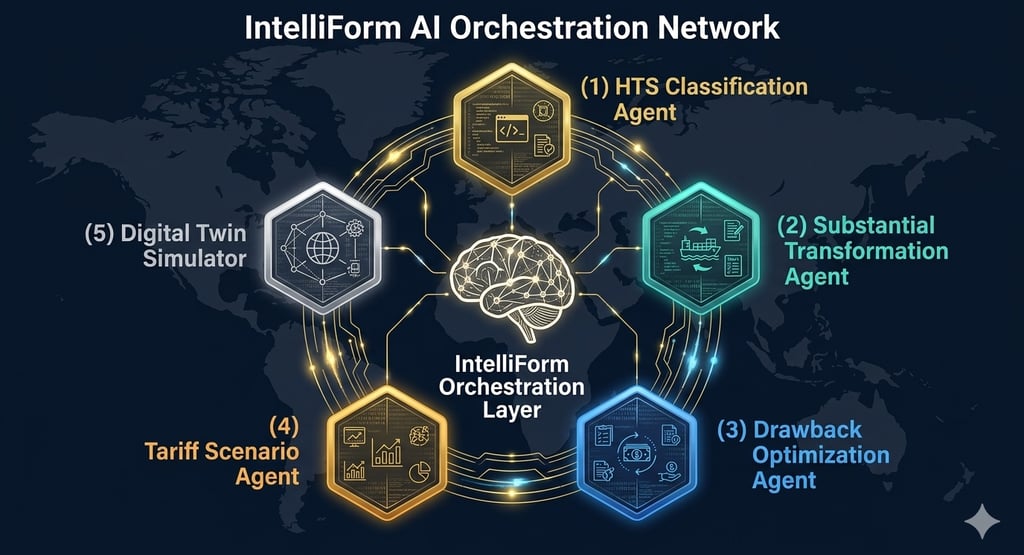
For specialty chemical supply chains, the agentic AI stack decomposes into five distinct agent classes, each addressing a different layer of the tariff engineering problem.
Agent Class 1 — The HTS Classification Agent
This agent continuously monitors the USITC HTS revision feed, the Federal Register for new Section 232 inclusions and exclusions, and the CBP CROSS rulings database for precedents involving similar products. When any product in the active portfolio falls within two HS chapters of a new tariff action, it triggers a classification review workflow — before the importer encounters a surprise at the port.
A real operational benchmark: a chemicals company piloted AI agents for autonomous sourcing in consumables categories — automating tender preparation, supplier prequalification, and bid analysis. The result was a 20 to 30% improvement in procurement staff efficiency and a 1 to 3% gain in value capture. [11] The same agent architecture applied to HTS monitoring prevents back-duty liabilities before they accumulate.
Agent Class 2 — The Substantial Transformation Assessment Agent
This is the most technically sophisticated agent in the stack — and the one most specific to chemistry. It ingests the product's molecular structure, reaction pathway, processing steps, and country-of-origin documentation. It then runs a structured classification against CBP's substantial transformation criteria.
Chemical reaction check: Does any processing step in the U.S. create a new molecular entity? The agent cross-references the CBP HQ rulings database for analogous product decisions.
Name-character-use analysis: Does the processed output have a different commercial name, altered physical properties, or a distinct end-use market from the input material?
HTS tariff shift test: Does the processing cause a change in the 4-digit HS heading — the alternative origin rule pathway under 19 CFR § 102?
Binding ruling recommendation: If substantial transformation is probable but not certain, the agent drafts a CBP eRuling request with the relevant chemistry and ruling precedents attached — reducing the decision cycle from months to days.
Agent Class 3 — The Drawback Optimization Agent
This agent operates at the intersection of import records, production logs, and export documentation. It tracks every duty-paid import entry with its five-year drawback window. It matches import materials to exported finished products or commercially interchangeable substitutes by 8-digit HTS code. It calculates the maximum recoverable drawback across the full portfolio in real time. And it generates the CBP Form 7551 documentation package — manufacturing records, proof of export, entry summaries — in a format ready for submission by a licensed customs broker.
Most small and mid-size specialty chemical companies forfeit drawback claims entirely because the documentation burden exceeds the perceived effort. AI agents eliminate that calculus.
Agent Class 4 — The Supplier Risk and Tariff Scenario Agent
This agent runs continuous tariff scenario modeling across the active supplier base. Its decision logic works as follows: when the supplier origin is India, the product HTS falls within a tariff-sensitive category such as 2827.10, 3301.29, or 2902.60, and a Section 232 expansion event is detected, the agent executes four autonomous steps in sequence:
• Step 1 — Landed cost recalculation: the agent reprices the full cost of the incumbent supply chain under the new tariff rate, including freight, duty, and any applicable CVD stacking.
• Step 2 — Domestic supplier comparison: it queries available U.S.-origin alternatives for the same product category and generates a side-by-side total landed cost comparison.
• Step 3 — Dual-source recommendation: it produces a sourcing recommendation with margin impact projections for maintaining the Indian supplier, switching to a domestic source, or splitting volume between both.
• Step 4 — Procurement escalation: it flags the full analysis to the procurement lead at high priority — before the next purchase order is issued, not after the shipment clears customs.
According to IBM's April 2025 research on agentic supply chains, more than half of surveyed supply chain executives already report deploying AI agents to automate procurement workflows. [9] Gartner projects that by 2030, 50% of cross-functional supply chain management solutions will use intelligent agents to autonomously execute decisions.
Agent Class 5 — The Digital Twin Tariff Simulator
LSU, in partnership with FUEL and Syngenta in September 2025, demonstrated low-cost digital twins for chemical processing facilities built from phone scans and sensor streams — collapsing the cost of entry for operations of any scale. [12]
A supply chain digital twin for a specialty chemical distributor models the entire network as a graph of interconnected nodes — each carrying cost attributes (production costs, tariff layers, freight), time attributes (lead times, customs clearance cycles), and reliability attributes (supplier performance scores, geopolitical risk indices). [13] When a tariff policy changes, the twin instantly recalculates every affected landed cost across the network — surfacing which product-origin combinations are now uneconomic, which domestic alternatives are viable substitutes, and what the drawback-adjusted net cost of the incumbent supply chain actually is after recovery.
EY describes the value precisely: a strategic digital twin can model alternatives and determine a network design that allows a company to optimize across all chosen parameters in near real time, rather than spending weeks on manual recalculation. [14]
SECTION 04 — APPLIED TO CHEMRICH'S PRODUCT PORTFOLIO
This Isn't Abstract: How the Framework Maps to Real ChemRich Products
Every principle above applies to active shipments in ChemRich's portfolio. Here is the product-level analysis.
Calcium Chloride Dihydrate — HTS 2827.20.00
Currently dutiable from India at approximately 10 to 26% depending on the applicable tariff stack. Simple dissolution or blending in the U.S. does not change origin — CBP precedent is unambiguous here. However, reacting calcium chloride with ammonia to produce ammonium chloride and calcium hydroxide creates two distinct new chemical entities. Each carries a different HTS code. Each has a different tariff treatment. The reaction chemistry unlocks both an origin shift and a higher-margin product simultaneously. Where reaction-based processing is not feasible, substitution drawback is the most applicable recovery mechanism — particularly for product exported to Canadian or Latin American markets.
D-Limonene Technical Grade — HTS 3301.29 / 2902.60
D-Limonene is classified as a terpene hydrocarbon. It is one of the most commercially versatile bio-solvents in ChemRich's portfolio, and it is also one of the best candidates for reaction-chemistry-based origin conversion. Epoxidation of D-Limonene in the U.S. — the addition of an oxygen across the double bond — produces Limonene Oxide, classified under HTS 2910.90. That is a new compound, a new HTS chapter, and a potential origin shift to U.S. [5] Limonene sulfonate formation, producing an anionic surfactant, involves a chemical reaction that similarly creates a new molecular entity. These are not exotic chemistry pathways. They are well-established industrial processes. ChemRich's New Jersey facility could produce these high-margin derivatives from Indian-sourced D-Limonene, establishing U.S. origin on the finished product while serving the growing demand for bio-based surfactants and solvents in personal care, cleaning, and coatings markets.
IPA 99% (Isopropyl Alcohol) — HTS 2905.12.10
IPA from India faces the full tariff stack applicable to Indian-origin organic solvents. Simple redistillation — even to higher purity — does not constitute substantial transformation. But esterification of IPA with acetic acid to produce isopropyl acetate is a chemical reaction creating a new compound with a distinct HTS code, a distinct commercial use (fragrance, specialty solvent), and a distinct buyer base. Similarly, dehydration of IPA to propylene shifts the product to a completely different HS chapter. These derivative paths merit serious evaluation given the tariff differential between the Indian-origin IPA starting material and a U.S.-origin derivative product.
Specialty Mineral Salts — HTS Chapter 28
Inorganic salts are assessed under strict substantial transformation rules, and mere mechanical mixing of salts does not change origin under any CBP interpretation. However, double decomposition reactions — where two salts exchange ions to form two new salts — do create new chemical entities. The classic example relevant to ChemRich: sodium sulfate plus calcium chloride in solution yields calcium sulfate and sodium chloride through ionic exchange. Both products carry different HTS codes from both inputs. Batch reactor operations in a U.S. facility running these reactions could qualify simultaneously for origin shift on the output product and drawback on the Indian-origin input material.
Agrochemical Actives — HTS Chapters 29 and 38
This is the category where the most common misconception lives. Formulators — and their compliance teams — frequently assume that compounding an Indian active ingredient with carriers, adjuvants, and excipients at a U.S. facility establishes U.S. origin for the finished formulation. CBP's ruling record is consistent and unambiguous: mere formulation does not constitute substantial transformation. [6] The active ingredient's origin and its tariff rate govern the finished pesticide, herbicide, or plant growth regulator, regardless of where the formulation occurred. For agrochemical actives, origin optimization requires genuine chemical modification — not formulation. That means exploring reaction-based processing of generic actives into derivative compounds with distinct biological activity profiles and distinct downstream market positioning.
💡 STRATEGIC IMPLICATION FOR CHEMRICH NJ FACILITY
The critical operational insight: ChemRich's New Jersey facility is not just a storage and fulfillment node. For select products — D-Limonene derivatives, double decomposition salt products, IPA esters — it is a potential origin-conversion facility where U.S.-based reaction chemistry can legally establish domestic origin, reduce effective tariff burden, and create higher-margin products simultaneously. This requires batch reactor capability, not just blending tanks. The investment decision maps directly to specific product lines where the chemical reaction origin rule applies, and the ROI calculation should incorporate both the tariff savings and the margin premium on the derivative product.
SECTION 05 — THE INTELLIFORM™ LAYER
What IntelliForm™ Needs to Become to Execute This
ChemeNova LLC's IntelliForm™ platform is already designed around multi-objective formulation optimization — simultaneously balancing cost, performance, sustainability, and manufacturability. The natural extension, and the one that maps directly to the tariff engineering framework above, is three additional intelligence layers that transform IntelliForm™ from a formulation tool into a trade-aware chemistry platform.
Layer 1 — Trade Compliance Intelligence
A live feed from USITC HTS revisions, CBP CROSS rulings, Federal Register tariff actions, and the Section 232 inclusion request pipeline — parsed and cross-referenced against IntelliForm™'s active product catalog. When a relevant tariff event occurs, the system flags which products are affected, which HTS codes are at risk, and what the landed cost delta is before the next shipment moves. This converts tariff policy from an external shock into an anticipated variable.
Layer 2 — Molecular Identity Classifier
A structure-aware module that ingests SMILES strings or InChI identifiers for input materials and proposed processing outputs — then checks whether the transformation meets the chemical reaction origin rule criteria under 19 CFR § 102. This is a chemistry-native compliance tool that no generic trade management software provides, because generic TMS platforms do not understand molecular structures. They classify SKUs. IntelliForm™ understands the chemical identity of what is inside the SKU — which is the only basis on which the substantial transformation analysis can be correctly performed.
Layer 3 — Drawback Documentation Engine
An automated documentation assembler that pulls import entry data, production records, and export shipment data into CBP-compliant drawback claim packages — structured for submission by a licensed customs broker. The goal is to reduce the time-to-file from weeks of manual assembly to hours of agent-assisted generation. The bottleneck is not legal complexity. It is documentation overhead. AI eliminates that overhead.
McKinsey's February 2026 analysis of agentic AI in procurement found that procurement functions are currently using less than 20% of the data available to them for decision-making. [10] For ChemRich, the data already exists: import entry records, COAs, production logs, customer specifications, HTS classifications, export documentation. IntelliForm™ is the orchestration layer that converts that raw operational data into actionable tariff intelligence — in real time, continuously, and without adding headcount.
SECTION 06 — THE BUYER'S GUIDE: WHAT TO DEMAND FROM YOUR SUPPLIER IN 2026
If You Buy Specialty Chemicals, These Are the Questions to Ask
The tariff and compliance burden has historically sat on the importer. That is shifting. Deloitte's 2026 Outlook documents that buyers are now demanding suppliers co-invest in tariff mitigation — because supply chain reshuffling affects both sides of the commercial relationship. [7] Here is what a sophisticated procurement team should be demanding from any specialty chemical supplier in 2026.
Can you provide a binding CBP classification ruling for our key products? A supplier holding a binding eRuling from CBP's CROSS system has legal certainty on classification. A supplier relying on a customs broker's informal estimate does not. The distinction matters when CBP conducts an audit.
What is the exact HTS code for the specific grade and purity we are purchasing? A 2% purity difference can move a product between HTS sub-headings and into a completely different tariff rate bracket. Purity specification and classification must be explicitly linked in the commercial documentation.
Have you assessed whether your U.S. processing qualifies for origin shift under the chemical reaction rule? Most distributors have not conducted this analysis. A supplier that has — and can document it — is operating at a fundamentally different level of trade compliance sophistication than one that has not.
What is your drawback recovery rate on this product category? If the answer is zero, the supplier is forfeiting a statutory revenue recovery mechanism. Some portion of that recovered duty could be passed through in improved pricing or used to stabilize price volatility during tariff escalation cycles.
How does your supply chain documentation simultaneously satisfy EPA, FDA, and CBP audit requirements? Traceability documentation designed for one agency's standards does not automatically satisfy another's. An integrated traceability system that serves all three simultaneously is the 2026 standard for pharmaceutical and food-adjacent chemical supply.
What is your pre-modeled response to a 25% escalation in Indian-origin tariff rates? The tariff on Indian goods reached approximately 50% in 2025. [15] A supplier should have a pre-built contingency scenario ready — not an improvised answer developed after the escalation is announced.
Conclusion: The Chemical Company That Wins Tariffs Is the One That Understands the Chemistry
The chemical industry spends enormous intellectual energy on molecular design, process optimization, and formulation innovation. It has applied almost none of that energy to the regulatory classification of the molecules it produces and moves across borders. In 2026, that asymmetry is a structural liability.
The HTS code that governs a product's duty treatment is, at its core, a description of that product's chemistry — its molecular class, its functional group, its chapter under the Harmonized System. The rules of origin for chemicals under 19 CFR § 102 are built around chemical reactions. The drawback system turns on commercial interchangeability — a concept native to chemistry, not logistics.
This is not a trade compliance problem dressed in chemistry language. This is a chemistry problem. And the companies that treat it as one — with the technical depth, the agentic AI infrastructure, and the cross-border operational structure to act on what the analysis reveals — will extract margin from the tariff environment that their competitors are simply paying as a cost.
ChemRich Global's cross-border structure — India sourcing, U.S. processing and fulfillment — is not a hedge against tariffs. It is the physical substrate on which tariff engineering becomes possible. IntelliForm™ is the intelligence layer that makes it executable at scale.
REFERENCES & SOURCES
[1] U.S. International Trade Commission (USITC). Harmonized Tariff Schedule of the United States. hts.usitc.gov. Updated 2025–2026.
[2] GHY International (Aug 2025). '50% Section 232 Tariffs on 407 New Steel and Aluminum Derivatives Take Effect Aug. 18.' ghy.com.
[3] ArentFox Schiff (Aug 2025). 'US Commerce Adds 428 HTS Codes to Section 232 Steel and Aluminum Tariff List.' afslaw.com.
[4] Gaia Dynamics (Jan 2026). 'CBP Tariff Classification 101: What Importers Must Know in 2026.' gaiadynamics.ai.
[5] U.S. Customs & Border Protection. Preferential Rules of Origin — 19 CFR § 102. cbp.gov.
[6] U.S. CBP Headquarters Ruling HQ H289712 — Entecavir pharmaceutical API substantial transformation analysis. rulings.cbp.gov.
[7] Deloitte Insights (Dec 2025). '2026 Chemical Industry Outlook.' deloitte.com.
[8] GEP Blog (Feb 2026). 'Chemical Industry Spend Outlook 2026: Strategic Priorities Ahead.' gep.com.
[9] Deloitte Insights (Apr 2026). 'The Agentic Supply Chain in Manufacturing.' deloitte.com.
[10] McKinsey & Company (Feb 2026). 'Redefining Procurement Performance in the Era of Agentic AI.' mckinsey.com.
[11] Assembly Industries (Apr 2026). 'Agentic AI in Procurement: Benefits, Use Cases & Implementation.' assembly-industries.com.
[12] Lengreo / LSU–Syngenta Partnership (Sep 2025). 'Digital Transformation in Chemical Industry: 2026 Guide.' lengreo.com.
[13] arXiv (Apr 2025). 'A Theoretical Framework for Graph-based Digital Twins for Supply Chain Management.' arxiv.org/abs/2504.03692.
[14] EY United States. 'Can a Supply Chain Digital Twin Make You Twice as Agile?' ey.com.
[15] Chemical & Engineering News (Feb 2026). 'Indian Chemical Sector's Aspirations Will Face Roadblocks.' cen.acs.org.
[16] Tuttlelaw.com (2021). 'Fundamentals of Customs Law: Substantial Transformation' — CBP rulings on Acyclovir, Ponstel, Crestor pharmaceutical origin determinations.
[17] SupplyChainBrain (Apr 2026). 'Why 2026 Is the Year of AI Agents for Autonomous Procurement.' supplychainbrain.com.
© 2026 ChemRich Global · chemrichgroup.com · ChemeNova LLC — IntelliForm™ · All rights reserved.

Chemical Solutions
Trusted partner for industries seeking high-quality chemicals, custom manufacturing solutions, and advanced pharmaceutical equipment.
Innovation
Growth
© 2025. All rights reserved.
Connect
Chemrich Global.