The 2026 Agentic Shift: How Chemrich Global is Redefining Custom Manufacturing with ChemeNova AI
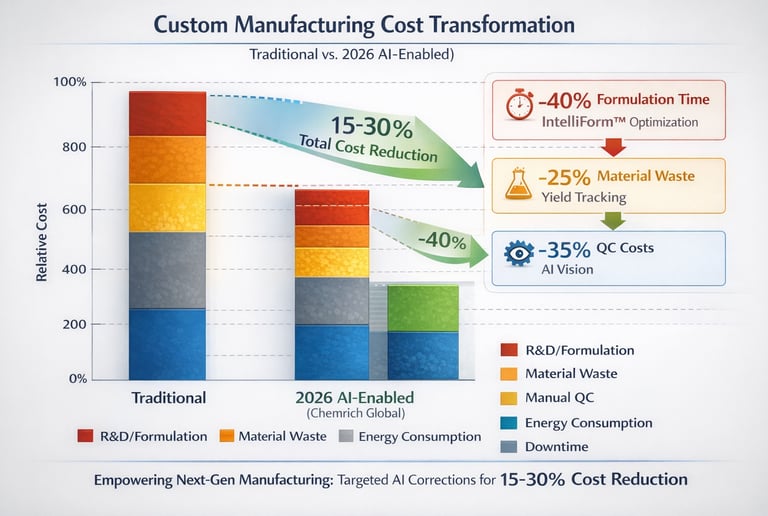
In 2026, Chemrich Global is revolutionizing custom manufacturing by integrating Agentic AI to slash production costs by up to 30% . Through the proprietary ChemeNova LLC platform and IntelliForm™ software, we eliminate operational "leaks" such as unplanned downtime and material waste. Our advanced facilities in New Jersey and India leverage machine learning to offer high-precision, low-volume production with bulk-commodity price efficiency. By bridging industrial legacy with digital intelligence, Chemrich delivers sustainable, compliant solutions that allow pharmaceutical and food sector partners to thrive amidst rapid disruption .
shehan makani | eshan makani
2/16/202611 min read
The Renaissance of Intelligent Chemical Synthesis: Strategic Integration of Agentic AI and Machine Learning in the Chemrich Global Ecosystem for 2026
The global chemical manufacturing sector in 2026 stands at a transformative juncture where the convergence of digital intelligence and physical production has moved beyond speculative pilot projects into a standardized industrial framework. As manufacturers navigate a landscape characterized by persistent material price volatility, stringent environmental mandates, and a critical shortage of traditional engineering talent, the adoption of Artificial Intelligence (AI) and Machine Learning (ML) has become the primary differentiator between market leaders and stagnant enterprises.1 Within this paradigm, Chemrich Global has emerged as a cornerstone of innovation, effectively utilizing its thirty-year legacy of industrial chemistry to anchor a new generation of AI-enhanced process solutions, primarily through the proprietary ChemeNova™ platform.4 The strategic implementation of these technologies allows for a radical restructuring of custom manufacturing costs, enabling high-precision, low-volume production at price points previously reserved for bulk commodity operations.6
The Macro-Economic Imperative for Digital Transformation in 2026
The economic environment of 2026 is defined by sharper cost pressures than the previous decade, as energy costs remain structurally high and global trade frictions necessitate localized, resilient supply chains.2 Manufacturers are increasingly turning to digital transformation as a mechanism to protect margins without passing costs to price-sensitive customers.2 Global spending on AI is projected to reach approximately $2 trillion by the end of 2026, a growth trajectory fueled by the maturation of generative models and the widespread deployment of AI infrastructure across discrete and process industries.10 In the chemical sector, specifically, the urgency to implement AI at scale is driven by the realization that companies failing to adopt these tools risk becoming uncompetitive within a single fiscal year.1
The impact of these investments is reflected in significant productivity gains and waste reduction metrics. Research indicates that chemical companies successfully deploying custom AI solutions are witnessing cost reductions in the range of 15% to 30%.11 Furthermore, the automation of working hours via generative AI is estimated to augment approximately 31% of the total labor output in the industry, effectively addressing the talent gap created by an aging workforce, with 30% of current professionals expected to retire by 2030.12
Chemrich Global: Bridging Industrial Legacy with Computational Intelligence
Since its inception in 1994, Chemrich Global has established a robust international presence, operating high-purity organic and inorganic manufacturing facilities in both the United States and India.4 This global infrastructure allows the company to serve as a vital link in the supply chains of pharmaceuticals, agrochemicals, food processing, and industrial manufacturing sectors.15 In 2026, the company’s strategic focus has shifted toward integrating its physical assets—such as the New Jersey facility’s precision-engineered stainless steel vessels—with a digital "nervous system" powered by machine learning.16
Chemrich’s custom manufacturing capabilities are designed to scale from small-scale R&D batches to large-scale commercial production, supported by innovative machinery for formulation, processing, centrifugation, and packaging.14 The value proposition offered by Chemrich Global in 2026 centers on its ability to deliver compliant and reliable supply solutions while simultaneously optimizing the cost-performance ratio through the ChemeNova™ suite of AI tools.4
The ChemeNova™ Platform: A Nexus of Green Chemistry and AI
ChemeNova™ represents the technological vanguard of the Chemrich ecosystem, offering a multi-faceted approach to chemical innovation that combines open scientific inquiry with industrial rigor.5 The platform is designed to bridge the gaps created by proprietary R&D silos and fragmented supply chains by offering scalable, customizable chemical systems.5
Key pillars of the ChemeNova LLC strategy include:
IntelliForm™ Software: A machine-learning formulation engine that runs multi-objective optimizations, balancing sustainability metrics against cost and manufacturability to propose eco-friendly blends.17
Predictive Process Control: Utilization of real-time data to monitor production variables, ensuring tighter control over reaction kinetics and energy consumption.4
AI-Enhanced Sourcing: A marketplace architecture designed to connect low-MOQ (Minimum Order Quantity) buyers with verified suppliers, optimizing pricing and real-time supply intelligence.7
Deep Dive: Automation and Machine Learning as Cost-Reduction Leaks
The transition to a lower-cost manufacturing model at Chemrich Global is facilitated by targeting the "biggest leaks" in the production lifecycle: scrap, downtime, and inefficient scheduling.2 By applying machine learning to these specific areas, the company achieves measurable returns within months rather than years.2
Predictive Maintenance and Asset Optimization
Traditional reactive maintenance approaches often result in unplanned downtime that disrupts entire supply chains. In 2026, Chemrich utilizes AI to transform unexpected breakdowns into scheduled interventions.2 By capturing and analyzing sensor data—including vibration patterns, thermal anomalies, and pressure fluctuations—the ChemeNova™ system identifies early warning signs of mechanical fatigue.2
For instance, if a high-throughput centrifuge at the New Jersey facility exhibits a 5% deviation in its torque baseline, an AI agent can autonomously adjust the feed rate to prevent immediate failure while drafting a repair plan for the maintenance team to review.8 This proactive orchestration can lead to a 43% reduction in unplanned downtime and extend the operational lifespan of expensive capital equipment.20
AI-Based Vision Systems for Quality Assurance
The implementation of computer vision systems on the factory floor has redefined quality control standards. Chemrich integrates YOLOv8-based deep learning models to perform real-time detection of defects during the formulation and packaging stages.20 These systems are capable of identifying deviations that are imperceptible to human inspectors, such as microscopic clinching failures in metal treatment or slight color variations in specialty coatings.2
The integration of AI vision offers three primary benefits:
Scrap Reduction: Early detection of defects prevents the continued processing of faulty batches, saving significant material costs.2
Labor Efficiency: Manual inspection time is reduced by approximately 35%, allowing engineers to focus on higher-value root-cause analysis.2
Global Quality Symmetry: Defect patterns recognized at one facility are instantly uploaded to the cloud, updating the detection models across all global sites to ensure consistent quality standards.2
Innovation Benchmarks (August 2025 – February 2026)
The last six months have provided critical breakthroughs that serve as technical reference points for Chemrich Global’s 2026 strategy. These developments illustrate the potential for AI to move beyond mere prediction into the realm of autonomous experimentation and discovery.
The GPT-5 and Ginkgo Bioworks sfGFP Benchmark (February 2026)
A watershed moment in chemical and biological manufacturing occurred in February 2026 when OpenAI and Ginkgo Bioworks announced that GPT-5 had autonomously optimized a cell-free protein synthesis (CFPS) process.23 The AI system designed and iterated through 36,000 unique reaction compositions, ultimately establishing a new state of the art that reduced the cost of producing superfolder green fluorescent protein (sfGFP) by 40%.24
The "learning" from this benchmark is profound: the AI model identified that minor changes in buffering and polyamines—parameters often considered secondary by human researchers—had outsized impacts on cost efficiency.23 Furthermore, the system autonomously converged on the conclusion that boosting protein yield per unit of expensive input (lysate and DNA) was the most effective leverage point for cost reduction, a strategy it refined over six iterative rounds with minimal human intervention.23
Yale University’s MOSAIC Platform (January 2026)
In January 2026, Yale University researchers introduced MOSAIC, an AI platform powered by 2,498 individual AI "experts," each specializing in a distinct niche of chemical reactions.26 MOSAIC generates experimental procedures for synthesizing compounds, including those that do not currently exist, by culling expertise from across diverse chemical spaces—from catalysts to cosmetics.26 This framework allows Chemrich Global to navigate complex synthesis pathways more efficiently than using standard large language models, effectively acting as a "Google Maps" for navigating chemical synthesis.26
The Chemputer and DL Integration (December 2025)
The Cronin Group’s advancements in "Chemputation" reached a significant milestone in late 2025 with the integration of programmable microwave modules into the Chemputer platform.27 Controlled by the Chemical Description Language (DL), this system allows for the automated execution of microwave-driven synthesis, ensuring high repeatability and precision.27 For custom manufacturing, this represents the ability to "code" a molecule and have it synthesized by robotic hardware, a process that significantly reduces human error and liberates chemists to focus on creative innovation.27
Sustainability and the Circular Economy in 2026
At Chemrich Global, innovation is intrinsically linked to green chemistry principles. The objective is to deliver "automated, sustainable chemical solutions" that help clients meet tightening global carbon disclosure and circular economy mandates.17 By 2026, sustainability has transitioned from a compliance cost to a competitive advantage.29
Green Solvents and Bio-Based Surfactants
Chemrich has prioritized the production and formulation of green solvents, such as D-Limonene, which serves as a bio-based alternative for cleaning, coatings, and degreasing across food, pharma, and industrial sectors.15 Through ChemeNova™ AI, the company designs bio-surfactant blends (e.g., APGs, sucrose esters) that are optimized for biodegradability, viscosity, and cost.17
The predictive modeling capabilities of ChemeNova™ allow for "responsible substitution," where the AI identifies safer, greener replacements for traditional surfactants based on toxicity, VOC (Volatile Organic Compound), and lifecycle data.17 This approach ensures that custom formulations are not only effective but also compliant with international standards such as REACH and RoHS.4
Digital Traceability and Material Yield Tracking
To support the circular economy, Chemrich integrates advanced-recycled intermediates and bio-feedstocks into its new formulations.17 Each batch produced is accompanied by digital traceability that tracks material origin, carbon intensity, and compliance data.17 On the factory floor, automated weighing and vision systems measure yield continuously, correlating batch inputs with actual consumption patterns to reduce scrap rates.30
This level of precision allows Chemrich to offer its clients:
Carbon Footprint Reduction: Quantifiable decarbonization data across the entire process.5
Resource Efficiency: Optimized use of water, energy, and raw materials.5
Toxin Elimination: Proactive replacement of hazardous reagents during the formulation stage.5
Agentic AI: Transitioning from Prediction to Autonomous Action
The most significant shift in Industry 4.0 during 2026 is the emergence of "Agentic AI." Unlike previous AI iterations that required constant human prompting, agentic systems act on their own initiative to solve complex problems and orchestrate multi-step operations.9
AI Agents on the Factory Floor
At Chemrich Global, AI agents are integrated into the "nervous system" of the manufacturing facilities.9 These agents monitor streams of data from thousands of equipment sensors and, when a deviation is detected, they do not merely alert the operator; they proactively coordinate a response.19 For example, if a supply chain delay is detected for a specific reagent, an agent can autonomously check capacity across other facilities, model "what-if" scenarios for production rescheduling, and suggest optimized recommendations to the planning team.8
The Shift Toward "Lights Out Labs"
The integration of agentic AI with robotic cobots (collaborative robots) is paving the way for "Lights Out Labs" and manufacturing lines that can operate unattended.32 These systems handle hazardous chemicals, automate lengthy setup workflows, and ensure consistent repeatability.32 For Chemrich Global, this means the ability to run 24/7 operations with minimal incremental workforce costs, allowing for scalable production that remains cost-effective even for highly complex, low-volume custom orders.19
Strategic Implementation of AI for Peers and Partners
For manufacturers looking to emulate the success of Chemrich Global in 2026, the pathway to AI-driven cost reduction involves a phased, outcome-focused strategy.
Step 1: Identify High-Value, Low-Risk Opportunities
The first step is to pinpoint data-intensive processes where friction is highest, such as root cause analysis for quality issues or the procurement of spare parts.9 Starting with non-production-critical processes allows for the validation of AI models without risking catastrophic system failure.9
Step 2: Establish "Human-in-the-Loop" Governance
As AI systems gain more autonomy, establishing robust governance frameworks is non-negotiable.9 Human validation should be required for agents executing safety-critical or high-value financial actions.9 This ensures that autonomous decisions remain aligned with broader organizational goals and regulatory requirements.9
Step 3: Focus on Interoperability and Logic
The most effective AI implementations are those that can query existing SQL databases and interact with APIs rather than just processing documents.9 Manufacturers should prioritize platforms that offer architectural openness, allowing for the seamless integration of instruments, models, and workflow decisions.34
Conclusion: The New Standard of Custom Chemical Excellence
By mid-2026, the chemical industry has definitively moved past the era of "pilot purgatory" into a period of scaled, intelligent operations.9 The integration of machine learning and agentic AI at Chemrich Global has demonstrated that the historical trade-offs between customization, speed, and cost can be overcome through digital orchestration.4 Through the ChemeNova™ platform, the company provides a comprehensive ecosystem where green chemistry and computational intelligence converge to deliver high-purity solutions across the pharmaceutical, food, and industrial sectors.5
The findings from the GPT-5 benchmarks and the emergence of specialized platforms like MOSAIC underscore a clear trajectory: success in the 2026 marketplace favors organizations that treat AI not as a technology overlay, but as a foundational structural capability.23 As Chemrich Global continues to expand its manufacturing presence in the U.S. and India, it remains dedicated to fostering a "cleaner, smarter world" through the application of science accelerated by sharing and innovation.5 For professional peers and industrial partners, the message is clear: the ability to adjust production cycles in 24 hours based on predictive data is the new benchmark for competitive survival.9
Works cited
ABI Research's Top 5 Manufacturing Trends to Know in 2026, accessed on February 16, 2026, https://www.abiresearch.com/blog/top-manufacturing-trends
AI-Driven Cost Reduction in Manufacturing: What Will Work in 2026 - Accedia, accessed on February 16, 2026, https://accedia.com/insights/blog/ai-driven-cost-reduction-in-manufacturing-what-will-work-in-2026
AI In Manufacturing: How 2025 Set The Stage For 2026 Trends - Versique, accessed on February 16, 2026, https://www.versique.com/ai-in-manufacturing-how-2025-2026-trends/
Bulk & Specialty Chemicals for Industrial Manufacturing | Chemrich ..., accessed on February 16, 2026, https://chemrichgroup.com/industrial-manufacturing
ChemeNova - "Innovating Sustainable Chemistry for Tomorrow's Industries.", accessed on February 16, 2026, https://chemenova.com/
Top 10 Manufacturing Trends to Watch [2026] | StartUs Insights, accessed on February 16, 2026, https://www.startus-insights.com/innovators-guide/manufacturing-trends/
Democratizing Chemical Procurement: An AI-Driven Marketplace for Low MOQ Sourcing in Specialty Chemicals - ResearchGate, accessed on February 16, 2026, https://www.researchgate.net/publication/394291772_Democratizing_Chemical_Procurement_An_AI-Driven_Marketplace_for_Low_MOQ_Sourcing_in_Specialty_Chemicals
Agentic AI For Businesses In 2026: Examples, Use Cases, & Benefits - DevCom, accessed on February 16, 2026, https://devcom.com/tech-blog/agentic-ai-use-cases/
Manufacturing's 2026 Mandate: From AI Pilot to Agentic Profit - Dataiku, accessed on February 16, 2026, https://www.dataiku.com/stories/blog/manufacturing-ai-trends-2026
How AI Industry Growth is Affecting Business in 2026 & Beyond - Insight Global, accessed on February 16, 2026, https://insightglobal.com/blog/ai-industry-growth-impact/
Custom AI Solutions: A Catalyst for Chemical Industry Transformation - Elchemy, accessed on February 16, 2026, https://elchemy.com/blogs/chemical-market/custom-ai-solutions-a-catalyst-for-chemical-industry-transformation
How chemical companies are implementing AI - ICIS, accessed on February 16, 2026, https://www.icis.com/explore/resources/how-chemical-companies-are-implementing-ai/
Advanced Manufacturing and Factory Automation Company - Chemrich LLC | ManufacturingTomorrow, accessed on February 16, 2026, https://www.manufacturingtomorrow.com/company_directory/chemrich-llc/14042
Chemrich Global | Chemrich Global, accessed on February 16, 2026, https://chemrichgroup.com/
Industries | Chemrich Global, accessed on February 16, 2026, https://chemrichgroup.com/industries
Products | Chemrich Global, accessed on February 16, 2026, https://chemrichgroup.com/products
Future-Ready Chemistry 2025: How Chemrich Global, ChemeNova AI & Custom Manufacturing Lead the Green Innovation Era, accessed on February 16, 2026, https://chemrichgroup.com/future-ready-chemistry-2025-ai-green-innovation
Shehan Makani, accessed on February 16, 2026, https://shehanmakani.blogspot.com/
Agentic AI in Manufacturing: Boosting Efficiency, Quality, and Uptime - Kanerika, accessed on February 16, 2026, https://kanerika.com/blogs/agentic-ai-in-manufacturing/
Practical AI for Manufacturing: From Back Office to Factory Floor | CBIZ, accessed on February 16, 2026, https://www.cbiz.com/insights/article/practical-ai-for-manufacturing-from-back-office-to-factory-floor
Agentic AI in Smart Manufacturing: Enabling Human-Centric Predictive Maintenance Ecosystems - MDPI, accessed on February 16, 2026, https://www.mdpi.com/2076-3417/15/21/11414
Artificial Intelligence (AI) and Automation-Driven Innovations in Chemical Engineering, accessed on February 16, 2026, https://www.mdpi.com/journal/processes/special_issues/926AV3AKB7
OpenAI's GPT-5 autonomously ran 36,000 protein synthesis experiments in Ginkgo Bioworks' cloud lab - R&D World, accessed on February 16, 2026, https://www.rdworldonline.com/openais-gpt-5-autonomously-ran-36000-protein-synthesis-experiments-in-ginkgo-bioworks-cloud-lab/
Ginkgo Bioworks' Autonomous Laboratory Driven by OpenAI's GPT-5 Achieves 40% Improvement Over State-of-the-Art Scientific Benchmark - PR Newswire, accessed on February 16, 2026, https://www.prnewswire.com/news-releases/ginkgo-bioworks-autonomous-laboratory-driven-by-openais-gpt-5-achieves-40-improvement-over-state-of-the-art-scientific-benchmark-302680619.html
GPT-5 lowers the cost of cell-free protein synthesis - OpenAI, accessed on February 16, 2026, https://openai.com/index/gpt-5-lowers-protein-synthesis-cost/
New 'recipes' for accelerating chemistry discoveries – with a dash of AI | Yale News, accessed on February 16, 2026, https://news.yale.edu/2026/01/19/new-recipes-accelerating-chemistry-discoveries-dash-ai
The Cronin Group - School of Chemistry - University of Glasgow, accessed on February 16, 2026, https://www.chem.gla.ac.uk/cronin/
Synthetic Automations: A Revolution from Stone Age to Modern Era, accessed on February 16, 2026, https://www.synthiaonline.com/resources/white-paper/synthetic-automations-a-revolution-from-stone-age-to-modern-era
From Lab to Market: The Journey of Green Chemistry Innovations | by Shehan Makani, accessed on February 16, 2026, https://medium.com/@shehanmakani/from-lab-to-market-the-journey-of-green-chemistry-innovations-7bd546c189c5
(PDF) Cost-Effective Sustainability for Small Manufacturers - ResearchGate, accessed on February 16, 2026, https://www.researchgate.net/publication/398077425_Cost-Effective_Sustainability_for_Small_Manufacturers
Agentic AI: A Chemical Industry Revolution Already Underway - SPOTCHEMI BLOG, accessed on February 16, 2026, https://blog.spotchemi.com/agentic-ai-a-chemical-industry-revolution-already-underway/
2026 Lab Informatics Trends | Clarkston Consulting, accessed on February 16, 2026, https://clarkstonconsulting.com/insights/2026-lab-informatics-trends/
2026 Manufacturing Industry Outlook | Deloitte Insights, accessed on February 16, 2026, https://www.deloitte.com/us/en/insights/industry/manufacturing-industrial-products/manufacturing-industry-outlook.html
The lab OS wars: 15 companies vying to enable AI-enabled labs at SLAS 2026 - R&D World, accessed on February 16, 2026, https://www.rdworldonline.com/the-lab-os-wars-15-companies-vying-to-enable-the-ai-enabled-labs/
SLAS 2026: Orchestration patforms, API-first instruments and the rise of semiautonomous labs - Drug Discovery and Development, accessed on February 16, 2026, https://www.drugdiscoverytrends.com/slas-2026-orchestration-patforms-api-first-instruments-and-the-rise-of-autonomous-labs/
AI in Chemical & Material Informatics Market Size 2026-2032, accessed on February 16, 2026, https://www.360iresearch.com/library/intelligence/ai-in-chemical-material-informatics
Chemical Solutions
Trusted partner for industries seeking high-quality chemicals, custom manufacturing solutions, and advanced pharmaceutical equipment.
Innovation
Growth
© 2025. All rights reserved.
Connect
Chemrich Global.